This book chapter, which presents a comprehensive research study involving İstanbul Technical University (İTÜ) faculty members Prof.Dr. Alper İlki (İTÜ Faculty of Civil Engineering) and Assoc.Prof. Dr. Çağlar Göksu Akkaya (İTÜ Disaster Management Institute), reveals the development of a groundbreaking method for strengthening existing substandard reinforced concrete (RC) structural elements against seismic effects.
The most striking outcome of this study, featured in the book titled "Engineering Materials, Structures, Systems and Methods for a More Sustainable Future," was that the proposed innovative strengthening technique increased the flexural capacity of the tested columns by up to 5 times compared to the reference specimen, and this improvement was maintained up to a 6% drift ratio. This achievement highlights the potential for a tangible and practical solution to enhance the earthquake resistance of the current building stock in Turkey.
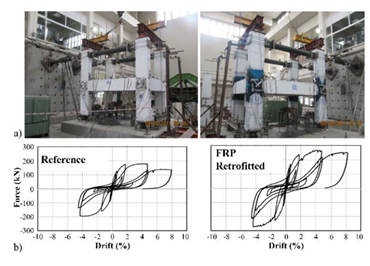
a) General view of the 3D frame test setup, b)
Test results for beam-column joints (modified from
Cosgun et al. 2012).
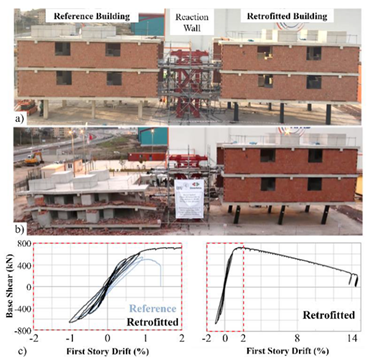
a) General view of the full-scale building
tests, b) Appearance at the end of the tests, c) Base shear-
first story drift relationships (modified from Ilki et al.
2018a, b).
Method: Innovative Approach Focused on Preserving Dimensions
This research proposed a novel retrofitting technique for the seismic flexural strengthening of substandard RC elements using longitudinal FRP reinforcement, featuring an installation approach that differs significantly from conventional methods.
The developed approach offers an advantage over conventional strengthening techniques by preserving the original dimensions of the structural elements. The application process began with the removal of the concrete cover, followed by the application of a cement-based structural repair mortar. The longitudinal FRP reinforcements (CFRP bars/laminates) were then externally embedded within the thickness of the original concrete cover.
Following these stages, various types of anchorage were tested for connecting the FRP reinforcement to the foundation, and the most effective anchorage detail was determined. Finally, the process was completed with transverse CFRP wrapping and the application of the final cement-based structural repair mortar layer.
The experiments were conducted on plain-bar cantilever RC column specimens with low-strength concrete and inadequate transverse reinforcement spacing to simulate typical substandard structural characteristics, subjected to reversed cyclic horizontal displacements.
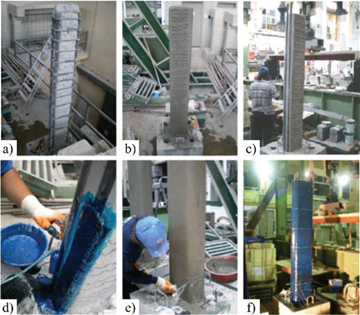
Retrofitting technique proposed by Goksu
et al. (2012): a) Removal of cover concrete, b) application
of cement-based structural repair mortar, c) installation
of the CFRP rods/precured laminates, d) application of
CFRP anchorages to the footing, e) application of final
layer of cement based structural repair mortar, and f)
wrapping with CFRP in transverse direction (modified
from Goksu et al. 2012).
Significance and Contributions of the Study
The work presented in this book chapter is highly significant, particularly for offering practical solutions to the unique deficiencies of the existing building stock in Turkey. This developed method provides a high-performance, dimension-preserving solution to the widespread problem of inadequate flexural strength in substandard structures.
These findings reconfirm the ability of FRP composites to significantly enhance performance, even in low-strength structures. The study not only dramatically increased the flexural capacity but also provided valuable guidance for practical applications by determining the effectiveness of different anchorage types for FRP reinforcements.
Such academic research directly contributes to strategies for improving the seismic performance of existing buildings and reducing disaster risk.
Click here for the book chapter.